|
| | WinFormsGpuGameHost (WinFormGpuRenderSurfaceControl renderSurface) |
| | Initializes a new instance of the WinFormsGpuGameHost class.
|
| override void | OnInputConfigured () |
| | Called after input is configured during engine startup to initialize widget input for the render surface host.
|
| | WinFormsGameHostBase (Control renderSurface, Action< Scene, bool > bindScene) |
| | Initializes a new instance of the WinFormsGameHostBase class.
|
| override void | ConfigurePlatform () |
| | Configures Windows Forms-specific platform features, including audio format support.
|
| override void | ConfigureKeyboard () |
| | Configures the keyboard adapter for the Windows Forms render surface.
|
| override void | ConfigureMouse () |
| | Configures the mouse adapter for the Windows Forms render surface.
|
| override void | ConfigureGamepads () |
| | Configures gamepad support. By default, this method initializes the XInput gamepad manager, but it can be overridden in derived classes to provide custom gamepad configuration.
|
| override void | ConfigureTouch () |
| | Configures touch input. By default, this method does not perform any actions, but it can be overridden in derived classes to set up touch input handling.
|
| override void | BindScene () |
| | Binds the current scene to the render surface host.
|
| override void | OnSceneBound () |
| | Called after the current scene has been bound to the Windows Forms render surface host.
|
| virtual void | OnConfigurePlatform () |
| | Provides a hook for configuring platform-specific settings during initialization.
|
| virtual void | OnKeyboardAdapterInitialized () |
| | Called after the keyboard adapter has been initialized. Override to perform additional keyboard setup.
|
| virtual void | OnMouseAdapterInitialized () |
| | Called after the mouse adapter has been initialized. Override to perform additional mouse setup.
|
| virtual void | OnGamepadManagerInitialized () |
| | Called after the gamepad manager has been initialized. Override to perform additional gamepad setup.
|
| virtual void | OnTouchAdapterInitialized () |
| | Called after the touch adapter has been initialized. Override to perform additional touch setup, such as attaching gesture recognizers.
|
| void | InitializeWidgetInput (RenderSurfaceHostBase renderSurfaceHost) |
| | Initializes widget input routing for the supplied render surface host.
|
| virtual void | OnInitializing () |
| | Runs before the host initialization sequence begins.
|
| void | ConfigureLogging (LogLevel logLevel) |
| | Configures the logging level used by Gondwana.
|
| void | ConfigurePlatform () |
| | Configures platform-specific services, adapters, and render infrastructure.
|
| void | ConfigureInput () |
| | Configures keyboard, mouse, gamepad, and touch input.
|
| void | InitializeGameContent () |
| | Initializes game-specific content, the scene graph, and scene objects.
|
| void | LoadContent () |
| | Loads assets, tilesheets, and animation cycles.
|
| virtual void | LoadAssets () |
| | Loads textures, sounds, and other game assets.
|
| virtual void | LoadTilesheets () |
| | Loads tilesheet definitions.
|
| virtual void | LoadAnimationCycles () |
| | Loads animation cycle definitions.
|
| void | CreateSceneGraph () |
| | Creates the initial scene and its views.
|
| virtual void | OnSceneGraphCreated () |
| | Runs after the scene graph has been created but before the scene is bound.
|
| virtual Scene | CreateInitialScene () |
| | Creates the initial scene for the game.
|
| virtual void | CreateInitialViews () |
| | Creates the initial views and viewports used to render the scene.
|
| void | InitializeSceneObjects () |
| | Creates sprites and direct drawings for the current scene.
|
| virtual void | CreateSprites () |
| | Creates sprite objects for the current scene.
|
| virtual void | CreateDirectDrawings () |
| | Creates direct drawings and widgets for the current scene.
|
| void | InitializeEngine (string? configPath, bool? autoSaveConfig) |
| | Initializes the Gondwana engine using the default file-backed configuration store.
|
| void | InitializeEngine (string? configPath, bool? autoSaveConfig, IEngineConfigurationStore? configurationStore) |
| | Initializes the Gondwana engine.
|
| virtual void | OnEngineInitialized () |
| | Runs after the engine has been initialized but before it has been started.
|
| void | StartEngine () |
| | Starts the engine using the synchronization context returned by GetSynchronizationContext.
|
| virtual void | StartEngineCore (SynchronizationContext syncContext) |
| | Starts the engine using the supplied synchronization context.
|
| virtual ? SynchronizationContext | GetSynchronizationContext () |
| | Gets the synchronization context used to start the engine.
|
| virtual void | OnEngineStarted () |
| | Runs after the engine has been started.
|
| virtual void | OnInitialized () |
| | Runs after the full host initialization sequence has completed.
|
| virtual void | UnhookEvents () |
| | Unhooks custom event handlers during disposal.
|
| void | StopEngine () |
| | Stops the engine during host disposal.
|
| virtual void | StopEngineCore () |
| | Performs platform-specific engine shutdown work.
|
| void | DisposeEngine () |
| | Disposes the engine instance.
|
| virtual void | OnDisposing () |
| | Runs before managed resources are disposed.
|
| virtual void | OnDisposed () |
| | Runs after managed resources have been disposed.
|
| void | EnsureNotInitialized () |
| | Ensures that the host has not already been initialized.
|
| void | EnsureNotDisposed () |
| | Ensures that the host has not been disposed.
|
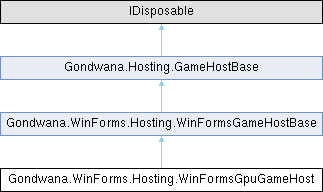
Provides a base class for hosting Gondwana games in Windows Forms applications using GPU-accelerated (OpenGL) rendering via WinFormGpuRenderSurfaceControl.
Definition at line 9 of file WinFormsGpuGameHost.cs.