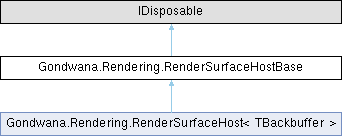
Represents a base class for hosting a render surface, providing functionality for managing rendering operations, backbuffer access, and integration with platform-specific adapters.
More...
|
| SKImage? | GlRenderAndSnapshot () |
| | Renders the current scene frame on the active GL/WebGL thread and returns a snapshot of the GPU backbuffer ready to be drawn to the platform surface.
|
| bool | GlRenderToCanvas (SKCanvas destinationCanvas) |
| | Renders the current scene frame and draws the GPU backbuffer surface directly to another GPU canvas. Linear scaling uses a scoped GPU texture snapshot because direct surface drawing does not support sampling options. No CPU pixel transfer is performed.
|
| bool | GlDrawCurrentFrameToCanvas (SKCanvas destinationCanvas) |
| | Draws the existing GPU backbuffer surface directly to another GPU canvas without rendering a new scene frame. Linear scaling uses a scoped GPU texture snapshot without CPU pixel transfer.
|
| SKImage? | GlSnapshotCurrentFrame () |
| | Returns a snapshot of the current GPU backbuffer without rendering a new scene frame.
|
| void | Dispose () |
| | Releases all resources used by this RenderSurfaceHostBase instance.
|
Represents a base class for hosting a render surface, providing functionality for managing rendering operations, backbuffer access, and integration with platform-specific adapters.
Definition at line 14 of file RenderSurfaceHostBase.cs.
◆ RenderSurfaceHostBase()
| Gondwana.Rendering.RenderSurfaceHostBase.RenderSurfaceHostBase |
( |
| ) |
|
|
protected |
Initializes a new instance of the RenderSurfaceHostBase class and registers it with the RenderSurfaceHostRegistry.
Registration ensures the render surface host is tracked for lifecycle management and can be enumerated by other system components.
Definition at line 30 of file RenderSurfaceHostBase.cs.
◆ Dispose() [1/2]
| void Gondwana.Rendering.RenderSurfaceHostBase.Dispose |
( |
| ) |
|
Releases all resources used by this RenderSurfaceHostBase instance.
This method unregisters the render surface host from the RenderSurfaceHostRegistry and releases any managed resources. Derived classes should override Dispose(bool) to release additional resources specific to their implementation.
After calling Dispose(), this instance should not be used. Calling Dispose() multiple times is safe and has no additional effect.
Definition at line 420 of file RenderSurfaceHostBase.cs.
◆ Dispose() [2/2]
| virtual void Gondwana.Rendering.RenderSurfaceHostBase.Dispose |
( |
bool | disposing | ) |
|
|
protectedvirtual |
Releases resources used by this RenderSurfaceHostBase instance and unregisters it from the RenderSurfaceHostRegistry.
- Parameters
-
| disposing | true to release both managed and unmanaged resources; false to release only unmanaged resources (called from finalizer). |
This method always unregisters the instance from the registry. Derived classes should override this method to release additional resources but must call the base implementation to ensure proper unregistration.
Reimplemented in Gondwana.Rendering.RenderSurfaceHost< TBackbuffer >.
Definition at line 440 of file RenderSurfaceHostBase.cs.
◆ GlDrawCurrentFrameToCanvas()
| bool Gondwana.Rendering.RenderSurfaceHostBase.GlDrawCurrentFrameToCanvas |
( |
SKCanvas | destinationCanvas | ) |
|
Draws the existing GPU backbuffer surface directly to another GPU canvas without rendering a new scene frame. Linear scaling uses a scoped GPU texture snapshot without CPU pixel transfer.
Call only from the active GPU paint callback while both surfaces share the current GRContext. This is intended for presentation loops that run more frequently than Gondwana's configured foreground/render cadence.
- Parameters
-
| destinationCanvas | The active platform GPU canvas. |
- Returns
true when the current GPU surface was drawn; otherwise false.
Definition at line 327 of file RenderSurfaceHostBase.cs.
◆ GlRenderAndSnapshot()
| SKImage? Gondwana.Rendering.RenderSurfaceHostBase.GlRenderAndSnapshot |
( |
| ) |
|
Renders the current scene frame on the active GL/WebGL thread and returns a snapshot of the GPU backbuffer ready to be drawn to the platform surface.
This method is intended to be called from the platform GPU paint callback while its GRContext is current. It is the GPU equivalent of the engine loop's RenderToBackbuffer + PresentBackbufferToAdapter pair; rendering and snapshot creation happen synchronously on the GPU-owning thread, with no CPU pixel transfer.
The returned SKImage is a lightweight GPU-backed view of the backbuffer texture. The caller must dispose it after drawing (typically with a using statement), and must do so within the same GPU paint callback to avoid aliasing with the next frame's rendering pass.
Returns null when BackbufferBase.IsGlThreadRendered is false (i.e. this is not a GPU-rendered surface).
- Returns
- A GPU-backed SKImage snapshot of the rendered frame, or
null if this surface does not use GL-thread rendering.
Definition at line 114 of file RenderSurfaceHostBase.cs.
◆ GlRenderToCanvas()
| bool Gondwana.Rendering.RenderSurfaceHostBase.GlRenderToCanvas |
( |
SKCanvas | destinationCanvas | ) |
|
Renders the current scene frame and draws the GPU backbuffer surface directly to another GPU canvas. Linear scaling uses a scoped GPU texture snapshot because direct surface drawing does not support sampling options. No CPU pixel transfer is performed.
Call only from the active GPU paint callback while both surfaces share the current GRContext. The destination is drawn at the origin using the destination canvas's current transform, followed by the adapter's aspect-preserving presentation transform.
- Parameters
-
| destinationCanvas | The active platform GPU canvas. |
- Returns
true when a GPU surface was rendered and drawn; otherwise false.
Definition at line 278 of file RenderSurfaceHostBase.cs.
◆ GlSnapshotCurrentFrame()
| SKImage? Gondwana.Rendering.RenderSurfaceHostBase.GlSnapshotCurrentFrame |
( |
| ) |
|
Returns a snapshot of the current GPU backbuffer without rendering a new scene frame.
This is intended for GPU presentation loops that run more frequently than Gondwana's configured foreground/render cadence. It allows the platform surface to re-blit the most recently rendered backbuffer while preserving Gondwana.Configuration.EngineConfiguration.TargetFPS.
Call only from the active GPU paint callback while the backbuffer's GRContext is current. The returned SKImage must be disposed before that callback returns.
- Returns
- A GPU-backed snapshot of the current backbuffer, or
null when the surface does not use GL-thread rendering.
Definition at line 385 of file RenderSurfaceHostBase.cs.
◆ Backbuffer
◆ Effects
◆ PresentationScale
| float Gondwana.Rendering.RenderSurfaceHostBase.PresentationScale |
|
get |
◆ RenderSurfaceAdapter
◆ Scene
| Scene Gondwana.Rendering.RenderSurfaceHostBase.Scene |
|
getabstract |
◆ Telemetry
| Diagnostics.? TelemetrySource Gondwana.Rendering.RenderSurfaceHostBase.Telemetry |
|
getset |
Neutral session-local measurements for this host; null when source capacity is exhausted or the shared collector is disposed.
Definition at line 17 of file RenderSurfaceHostBase.cs.
◆ ViewManager
| ViewManager Gondwana.Rendering.RenderSurfaceHostBase.ViewManager |
|
getabstract |
Gets the view manager that controls camera positions, viewports, and multi-view rendering for this render surface host.
The ViewManager instance managing all views associated with this render surface host.
The view manager enables split-screen, picture-in-picture, and minimap rendering by managing multiple views with independent cameras and viewports.
Definition at line 75 of file RenderSurfaceHostBase.cs.
◆ GpuRenderSynchronizationDiagnosticsCalculated
Occurs after a GPU render/snapshot call when a subscriber requests timing for the shared render-state synchronization gate.
Definition at line 86 of file RenderSurfaceHostBase.cs.